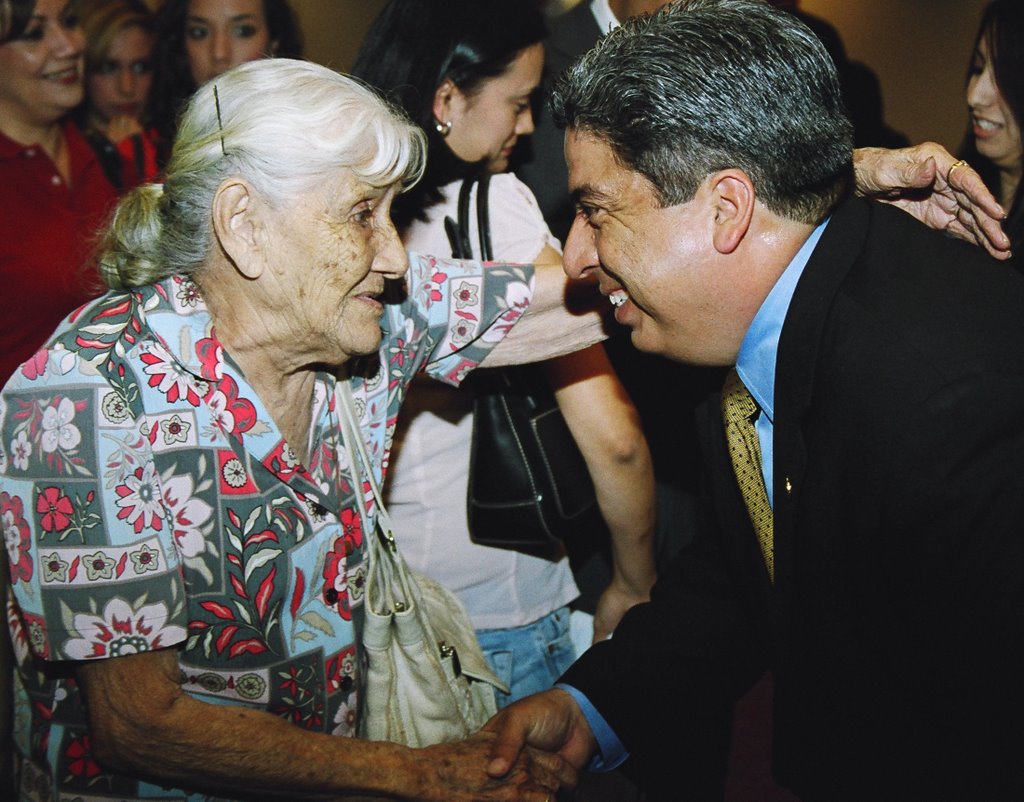
There was some expectation that Democrats would win one of the houses of Congress in this election cycle. Taking both houses of Congress was a bit of a suprise to the country. Here is an article from the Washington Post about the resulting turmoil in the Republican Party after their stunning loss.
Republicans' Angry Factions Point Fingers At Each Other
Showing posts with label Republicans. Show all posts
Showing posts with label Republicans. Show all posts
Thursday, November 09, 2006


Sunday, February 19, 2006
The South Texas Ranch Where Politicians Roam

More than a century before it became the scene of a vice presidential hunting accident, this humble stretch of property had connections to another gun incident.
On a manhunt in 1877, a hard-bitten Texas ranger named John B. Armstrong captured the notorious outlaw John Wesley Hardin after what the officer later described in a telegram back home as a "lively shooting" aboard a train in Florida. The capture made a hero of Mr. Armstrong, who bought a 50,000-acre plot from the owners of an old Spanish land grant using, according to one account, the $4,000 reward from the capture of the notorious gunman. When Mr. Armstrong died there in 1913, the land passed down to his heirs and soon was known by the family name.
Vice President Cheney's mishap on the property last weekend drew the curtain back on a place that has become a quiet destination for the powerful, rivaling Hyannisport, Kennebunkport and the Hamptons as a setting where important relationships have been nurtured. The rise of the Armstrong Ranch, and its even larger and more famous neighbor next door, the King Ranch, is as much a story of the rise of the Republican party in Texas, and George W. Bush as it is about the Armstrong family itself.
Over the last five decades, the Republican pilgrimage to the Armstrong Ranch has become a familiar ritual, dating back to the 1950's, when John Armstrong's descendant Tobin and his wife, Anne, first became active in Republican politics, putting them at the center of a small circle in a time when most Texans were still yellow dog Democrats. The South Texas property became a meeting place for rising political figures.
Now their children — including their daughter Katharine, who called her local newspaper to disclose the vice president's shooting of Harry M. Whittington — have inherited the perch. And even though Tobin Armstrong died at age 82 last year, invitations to the Armstrong Ranch remain sacred in Republican circles in the state — and are almost sure to remain so in the days ahead despite the site's recent infamy.
"When you say, 'I've been hunting with the Armstrongs,' or 'I've been down on the Armstrong Ranch,' that implies a certain level of status and insiderness," said Harvey Kronberg, the editor of The Quorum Report, the statewide political news publication. "The ranch itself is kind of a rite of passage for Texas Republicans. You go pay homage."
And many have paid their respects over the years — the Bushes and the Cheneys, Karl Rove, James A. Baker III, Senator Kay Bailey Hutchison and Gov. Rick Perry, have all been cited as participating in hunting trips or other social functions at the Armstrong Ranch. Mr. Cheney, in his one interview after the accident, made certain to note that Mr. Rove has also hunted there, declaring that both he and Mr. Rove are "good friends of the Armstrongs."
"If it could ever be said that a man could walk with kings yet keep the common touch, it was Tobin Armstrong," Mr. Cheney said at the funeral, according to the accounts at the time. The first lady, Laura Bush, also attended; three years earlier, when the British queen mother died, Anne and Tobin Armstrong accompanied Mrs. Bush as part of the United States delegation.
Ranches and power have gone hand in hand in Texas political history. The state's huge ranches — particularly the biggest, the South Texas ones — were patterned closely on the patron culture of the great Spanish ranches, with a landowner acting as almost a local sovereign, controlling the lives of the workers in his charge and deferred to in social and cultural matters, large and small.
The political power of the Texas ranches persisted into the 20th century. Representative Richard Kleberg came from the family that owned the King Ranch and was a powerhouse in Congress in the 1930's and 40's.
In the late 40's, opponents of young Lyndon B. Johnson accused him of stealing a United States Senate election by using the South Texas political bosses who were controlled by the ranch owners, something that Johnson always denied.
"Back in the '40's, Lyndon Johnson could still steal a Senate election in South Texas with the help of the big patrons," said Calvin Jillson, a political science professor at Southern Methodist University.
"But what happened is, in the late 60's and early 70's, is the feds came in and threw some people in handcuffs, along with some of the bosses of those South Texas counties, and it cleaned up a lot," he said. "But you notice, even today, you can still call the local sheriff and say, 'We've had an accident out on the ranch, not to worry, it's under control,' and the sheriff says, 'Yes ma'am, I'll drive out in the morning and we'll piece this thing together.' There's still a deference to the ranch owners that would astound most Americans."
If, in recent decades, the Armstrongs have been more politically connected than the other big, old ranch families, this is due in part to their personalities and to their overriding passion for transforming the Republican Party into a political force in Texas. But it is also because — unlike the Armstrong Ranch, which continued to be a family-run enterprise — many of the other big ranches, including the King Ranch, diversified into agribusiness conglomerates.
The Armstrongs derived their initial influence simply by being there: They were as close to aristocracy as the state had ever known, and became more so in 1944, when Tobin's brother married into the King family, whose adjacent ranch added even more wealth and prominence to the family.
Tobin Armstrong, who spent 48 years as the head of a prominent cattle industry association, married his wife, Anne, in 1950, and the pair spent the next five decades financing Republican candidates and serving in Republican administrations.
Mr. Armstrong had close ties to then Gov. Bill Clements, the first Republican to win the Texas Statehouse since Reconstruction — and whose campaign in 1978 was worked on by a young political operative named Karl Rove. When Mr. Rove opened his direct-mail consulting firm, Karl Rove & Company, beginning his career, it was with financial support from Mr. Armstrong.
By many accounts Mrs. Armstrong, the matriarch, was as much of a driving force in politics as her husband. A New Orleans native, from a wealthy family of her own, she was named counselor to President Richard Nixon. President Gerald Ford, for whom Mr. Cheney served as chief of staff, appointed her United States ambassador to Britain in 1976. In more recent years, she served on the boards of American Express and Halliburton, the energy company of which Mr. Cheney was chief executive before becoming vice president.
The family's relationship with George W. Bush is equally apparent: When he was governor of Texas, Mr. Bush appointed Mrs. Armstrong as a regent of Texas A & M, and made her daughter Katharine a member of the Texas Parks and Wildlife Commission; she later became the chairwoman. She also became a lobbyist, and her clients include Mr. Baker's law firm, Baker Botts. Lobbying records show that Ms. Armstrong made at least $760,000 lobbying for clients in Washington in 2004 and 2005, and at least $300,000 working for four separate clients in Texas during that same period.
In the 2000 presidential cycle, both Katharine Armstrong and her parents were listed as Bush campaign "pioneers," fund-raisers who attracted $100,000 in donations for the Republican team.
As the family's influence rose, "going down to the Armstrong Ranch" became a phrase heard in Republican and Bush administration circles, conjuring up images of party luminaries gathering, as they did last weekend, for intimate weekends away.
"These are the deep pocket people, and that's the ancient tradition of the region," said Bruce Buchanan, a professor of political science at the University of Texas at Austin. "It's just the way big money operators wield influence."
Mr. Buchanan added: "Here in Texas they just happen to use ranches. Up on the East Coast they use boats."
This peak into the South Texas political culture of the South Texas ranch country was brought to you via the New York Times.
Sunday, February 12, 2006
Republican Speaks Up, Leading Others to Challenge Wiretaps
When Representative Heather A. Wilson broke ranks with President Bush on Tuesday to declare her "serious concerns" about domestic eavesdropping, she gave voice to what some fellow Republicans were thinking, if not saying.
Attention in N.S.A. Debate Turns to Telecom Industry (February 11, 2006) Now they are speaking up — and growing louder.
In interviews over several days, Congressional Republicans have expressed growing doubts about the National Security Agency program to intercept international communications inside the United States without court warrants. A growing number of Republicans say the program appears to violate the Foreign Intelligence Surveillance Act, the 1978 law that created a court to oversee such surveillance, and are calling for revamping the FISA law.
Ms. Wilson and at least six other Republican lawmakers are openly skeptical about Mr. Bush's assertion that he has the inherent authority to order the wiretaps and that Congress gave him the power to do so when it authorized him to use military force after the Sept. 11, 2001, attacks.
The White House, in a turnabout, briefed the full House and Senate Intelligence Committee on the program this week, after Ms. Wilson, chairwoman of the subcommittee that oversees the N.S.A., had called for a full-scale Congressional investigation. But some Republicans say that is not enough.
The rest of the story.
Thursday, February 02, 2006
Boehner Wins Majority Leader Race Replacing DeLay

WASHINGTON, Feb. 2 — Representative John Boehner, an eight-term Congressman from far west Ohio, defeated Representative Roy Blunt of Missouri today in a stunning upset to succeed Tom DeLay as the House Republican majority leader.
Mr. Boehner received 122 votes to 109 for Mr. Blunt in a runoff made necessary by an inconclusive first ballot. The victory for Mr. Boehner signaled that many House Republicans are uneasy about the lobbying scandals that threaten to tar some of their party colleagues and wanted far more change than Mr. Blunt seemed to promise.
The first ballot ended inconclusively, with Mr. Blunt earning 110 votes, Mr. Boehner 79 and Representative John Shadegg of Arizona 40. Representative Jim Ryun of Kansas, the world-class miler of the 1960's, got two votes.
Mr. Shadegg and Mr. Ryun, who had not been an announced candidate for the post, then withdrew, leaving Mr. Boehner and Mr. Blunt to battle for a majority. There are 231 Republicans in the House, so 116 votes were needed for victory.
The rest of the NY Times story is here.
Thursday, January 26, 2006
Democrats in 2 Southern States Push Bills on Bible Study
 Democrats in Georgia and Alabama, borrowing an idea usually advanced by conservative Republicans, are promoting Bible classes in the public schools. Their Republican opponents are in turn denouncing them as "pharisees," a favorite term of liberals for politicians who exploit religion.
Democrats in both states have introduced bills authorizing school districts to teach courses modeled after a new textbook, "The Bible and Its Influence." It was produced by the nonpartisan, ecumenical Bible Literacy Project and provides an assessment of the Bible's impact on history, literature and art that is academic and detached, if largely laudatory.
The Democrats who introduced the bills said they hoped to compete with Republicans for conservative Christian voters. "Rather than sitting back on our heels and then being knocked in our face, we are going to respond in a thoughtful way," said Kasim Reed, a Georgia state senator from Atlanta and one of the sponsors of the bill. "We are not going to give away the South anymore because we are unwilling to talk about our faith."
The rest of the New York Times story.
Wednesday, January 11, 2006
House Leaders Consider Prohibition On Lobby Paid Travel
House Republicans, seeking to recover their standing with voters in the wake of a lobbying scandal, are considering a total ban on privately funded congressional trips, the lawmaker leading the reform effort said Wednesday.
Rep. David Dreier, R-Calif., said GOP leaders were "seriously considering" the need to eliminate all privately financed travel. "That would be a very strong statement. We want to be bold," said Dreier, chairman of the House Rules Committee.
The rest of the story.
Rep. David Dreier, R-Calif., said GOP leaders were "seriously considering" the need to eliminate all privately financed travel. "That would be a very strong statement. We want to be bold," said Dreier, chairman of the House Rules Committee.
The rest of the story.
Subscribe to:
Posts (Atom)